GEO vs SEO: what changed and what did not
In short
SEO gets your page into search results; GEO gets it quoted inside AI answers. AI answers still rely on search indexes, so good SEO is the base, and GEO adds clear, quotable answers and crawler settings on top.
SEO (search engine optimization) helps your page rank in a list of search results. GEO (generative engine optimization) helps your page get picked and quoted when an AI tool writes an answer instead of showing a list.
The two overlap more than most articles admit. AI answer tools look things up in search indexes first, so the old basics still carry most of the weight. What changed is what happens after the search, and how you can tell if it worked.

What stays the same?
The foundation stays the same. A page still has to be crawlable, indexed and worth reading.
Google is direct about this for its own AI features. To appear in AI Overviews or AI Mode, "a page must be indexed and eligible to be shown in Google Search with a snippet." It adds that you do not need new AI text files or special markup.
Microsoft's Copilot works the same way at its core. Its help page says Copilot builds a short query from your prompt and sends it to Bing. If Bing has never indexed your page, Copilot cannot find it.
So these SEO habits keep paying off:
- A clean site that crawlers can reach, with no accidental blocks
- One clear topic per page, with a good title and summary
- Content that answers real questions from real customers
- Signs of a real business: name, address, contact details, an About page
- Links from other trusted sites that mention you
What actually changed?
Three things changed, and they matter.
1. Fewer winners per question. A results page lists ten links. An AI answer usually links a handful of sources, and sometimes none. Coming fourth in Google still gets you seen. Being the fourth-best source for an AI answer may get you left out entirely.
2. Passages beat pages. The AI tool reads your page and lifts the part that answers the question. A page that states its answer in the first two sentences is easier to use than one that builds up to it. Headings phrased as questions help the tool find the right passage.
3. New crawlers with new rules. Each AI company runs its own bots, often several. OpenAI, for example, keeps separate bots for training and for search. A robots.txt file written five years ago may block a search bot you now want, or allow a training bot you would rather refuse. Our AI crawlers guide covers the current names.
How do the two compare side by side?
| SEO | GEO | |
|---|---|---|
| Goal | Rank high in a list of links | Be one of the few sources an AI answer uses |
| Where people see you | Search results page | Inside a written answer, as a citation or mention |
| Unit that wins | The whole page | A passage that answers one question |
| Main crawlers | Googlebot, bingbot | The same, plus OAI-SearchBot, PerplexityBot, Claude-SearchBot and others |
| How you measure it | Rankings, clicks, impressions | Citations and mentions; tools are newer and patchier |
| Still needs | Indexing, good content, trust | Indexing, good content, trust |
Can I measure GEO the way I measure SEO?
Not yet as well. SEO tools are mature. GEO measurement is new.
There is progress. In June 2026, Microsoft added reports to Bing Webmaster Tools that show where your content is cited in AI answers across Copilot and Bing. Microsoft calls its Citation Share metric "designed as an observational metric", which is an honest label.
For other assistants, there is no official dashboard that we know of as of November 2026. You can ask the assistants about your business yourself and note who they cite. That is slow, and answers vary from one try to the next, but it is real data.
Did any SEO tactics stop working?
Some features changed. Google stopped showing FAQ rich results, the expandable questions under a search listing, in May 2026. Its changelog says the feature "will no longer appear in Google Search results starting May 7, 2026."
That does not make FAQ sections useless. A visible list of real questions and plain answers still gives an AI tool something easy to quote. It just no longer earns extra space on a Google results page.
In our view, the tactics that age worst are the ones aimed at the ranking system instead of the reader. Keyword stuffing and thin pages written only to rank give an AI tool nothing worth quoting.
So what should a small business do differently?
Keep doing the SEO basics. Then add a GEO layer on top:
- Check that AI search crawlers are allowed in your robots.txt.
- Rewrite the first two sentences of each main page so they answer its main question.
- Put facts in text and tables: prices, hours, areas served, how long jobs take.
- Add a short FAQ with questions customers really ask, answered in plain words.
- Make sure your name, address and phone match everywhere, including in your structured data.
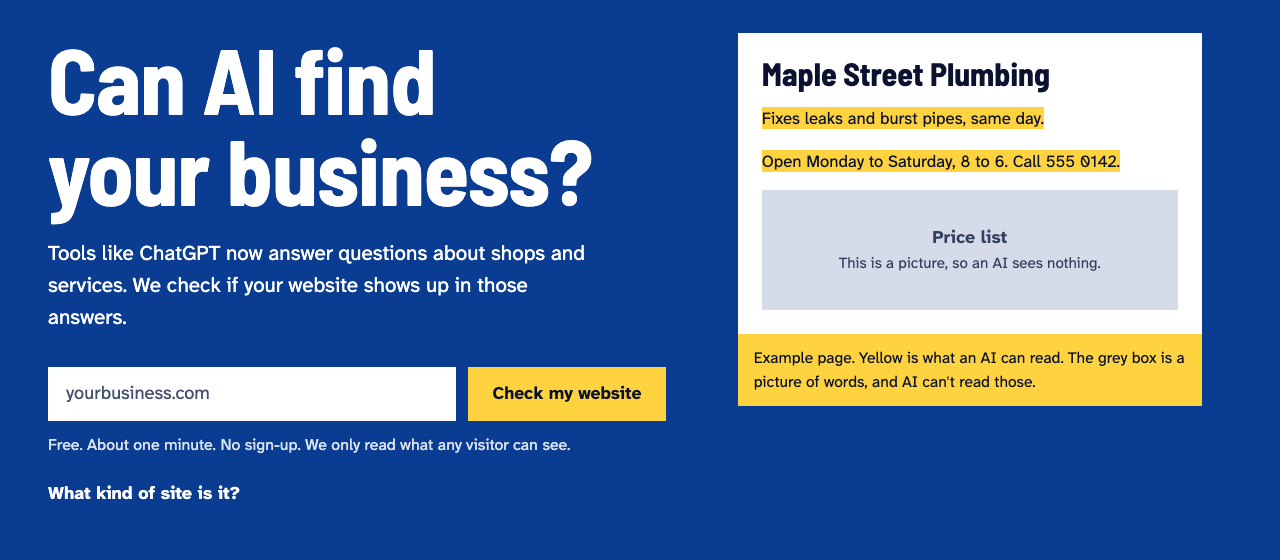
Our free scanner checks most of this list in about a minute. It reports readiness, not actual citations, and our methodology page explains each check.
Frequently asked questions
Is SEO dead because of AI answers?
No. AI answer tools still search an index first. Google, Microsoft and OpenAI all describe some form of search step in their own documentation. Weak SEO usually means weak GEO.
Do I need a separate GEO agency?
Usually not. Ask your current web or SEO person to review crawler access, opening sentences and structured data. Those are small jobs.
Does ranking first on Google mean ChatGPT will cite me?
Not necessarily. Each assistant uses its own mix of search sources and its own way of picking passages. Ranking well helps you get found, but the answer still goes to the clearest passage.
Which matters more for a small business right now?
For most, SEO still drives more visitors today. The GEO steps above are cheap, so it makes sense to do both at once.
Sources
- Google Search Central: AI features and your website
- Microsoft Support: How web search works in Microsoft Copilot Chat and agents
- Bing Blogs: New AI Visibility Insights in Bing Webmaster Tools (June 2026)
- OpenAI: Overview of OpenAI crawlers
- Google Search Central: Latest updates (FAQ rich result deprecation, May and June 2026)